Written October 20, 2026
Every Pixel Placed Deliberately
From incoherent early artwork to deliberate rooms and a sustainable asset workflow.
Looking back: October 18, 2026 to October 20, 2026
The first real frustration was the art. It was sloppy and did not feel cohesive. I called it pure AI slop. I also knew why. No real thought had gone into the approach, the tooling, the pipelines or the workflow. I was asking for artwork without having established enough of what would make it belong in this particular game.
My career as a software and DevOps engineer gave me experience to draw on. I knew how to define requirements, build processes and choose approaches I could keep using as the project grew. Applying that experience to the artwork helped me find direction. Establishing the guidelines and guardrails took effort. Once those pieces started coming together, cohesion became much easier.
The settlement huts made the improvement visible. They became smaller rooms within the screen, with margins around them that suggested small quarters in a larger world. Furnishings could explain what each place was for. The workshop had equipment and parts. The trading post had stock and counters. The elder’s hut had books, a bed and a place to visit.
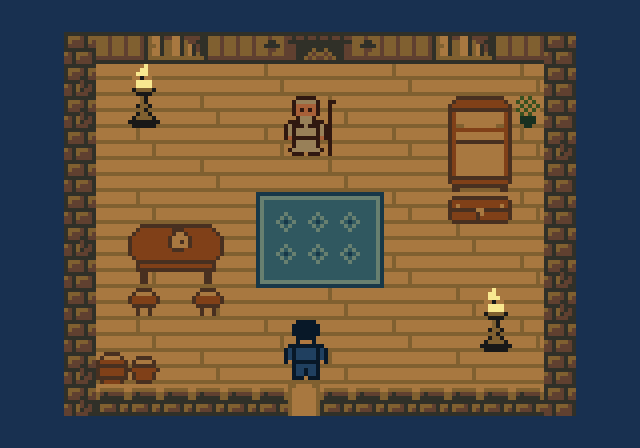
Elder’s hut, v0.5.18. Composed full-area ROM reference with the HUD omitted and a documentation player pose. This shows the revised room. I haven’t selected a verified earlier comparison image yet.
The guidelines made small visual decisions explicit. Floorboards needed to continue beneath furniture and through gaps. Objects spanning several tiles needed to read as continuous objects. Shelves, lights and wall borders needed to meet deliberately. Enlarged previews could reveal a broken seam, while the native view showed whether a collection of pixels actually read as a tool, a bed or a computer.
A detail can look convincing when enlarged and become an ambiguous mark at the size someone will actually play. The review process now asks for both views, repeated surfaces where appropriate, and representative scene context. I need to see an asset in the room as well as check its dimensions and colours.
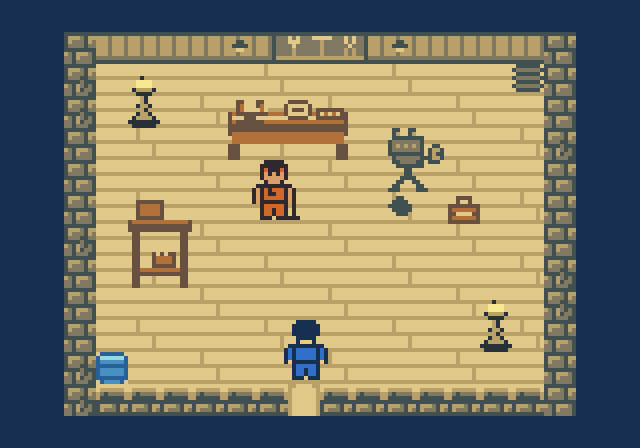
Powered workshop, v0.5.18. Historical composed ROM reference. This is not a current screenshot or evidence of an Aseprite/MCP authoring session.
Aseprite through MCP became another part of the workflow. Aseprite provides an actual pixel-art document with layers, frames and editable sources. MCP provides the connection through which an AI assistant can operate the application. The project’s creation workflows call for drawing and correcting the artwork there, inspecting it, and saving both the editable source and a native PNG.
The main hut revisions were made on October 18 through regional artwork generators. The committed Aseprite/MCP creation workflows followed on October 19. The improvement I remember spans those steps: better requirements, visual checks, guardrails and application tooling.
An idea becomes a sprite or tile with a defined size and palette. The source is reviewed, exported and converted into game data. The development ROM can preview supported PNGs in its asset browser. Placing an asset into the actual world remains a separate integration step, followed by scene captures and review in SameBoy. The browser gives an asset a place to be inspected before its role in the world is settled.
The Game Boy Color’s limits are part of those requirements. Sprites have three visible colours plus transparency. Background tiles have four colour entries. Palette choices and the pixels behind an object affect how it can join the scene. Keeping editable sources and deterministic conversion makes those constraints something the workflow can check consistently.
I’m proud of that pipeline. I can take an idea through to game inclusion with requirements and checks at each step. I could see the improvement in the huts. They had that sense that every pixel had been placed deliberately. They felt lived in and worked in.
I wanted to go back.