Written October 20, 2026
A Room Becomes a World
How a one-room tactical prototype grew into requests, homecomings and a complete opening chapter.
Looking back: October 15, 2026 to October 18, 2026
Once I saw the first version running, I realized I could keep going. It felt like the possibilities were limited only by my creativity. I had tools available to me, and I wanted to use them to make a tribute to the things and people that had influenced me. Something that might inspire someone else, or make them feel some of what I had felt playing those games.
The first recorded prototype, on October 15, had exploration and six-action-point combat. You could move around, encounter a raider and take turns fighting. Exploration and combat shared the same map. The place where you found trouble was also the place where you had to deal with it.
Looking back through the history, that room acquired a lot very quickly. Aiming became visible. Another raider made turn order matter. The yard developed firing lanes and routes around cover. Supplies gave the player something to recover, and extraction gave the mission an ending. Patrols and individual awareness meant enemies could be doing something before the player started fighting them.
Where I walked could affect who saw me. A shot could bring someone else into a fight. I was working toward the methodical combat I had pictured, with patrols and cover giving the player things to consider while exploring.
Movement itself took more than one attempt. The history includes an eight-direction exploration experiment on October 16, followed by a return to four-direction grid walking on October 17. The combat move cursor was a separate decision, letting the player choose a destination and see a route and its cost. I could try an approach, play it and change my mind. Getting it working didn’t mean I had to keep it.
As the game grew, I had to work within the hardware limits. The project moved from an unbanked prototype to a banked cartridge, and eventually to the current 128 KiB ROM. Performance work happened alongside the features. Drawing the screen, moving actors and preparing enemy navigation all had to fit into the time available. The development records contain revisions that were needed simply to keep those things working together smoothly.
By October 17, the settlement provided a reason to leave the yard and a reason to return. The elder had a request. The mechanic and trader had their own roles. Restoring water and power gave missions an effect on the place the player came home to. A basin could fill. Lamps could light. Progress could become visible in a familiar place.
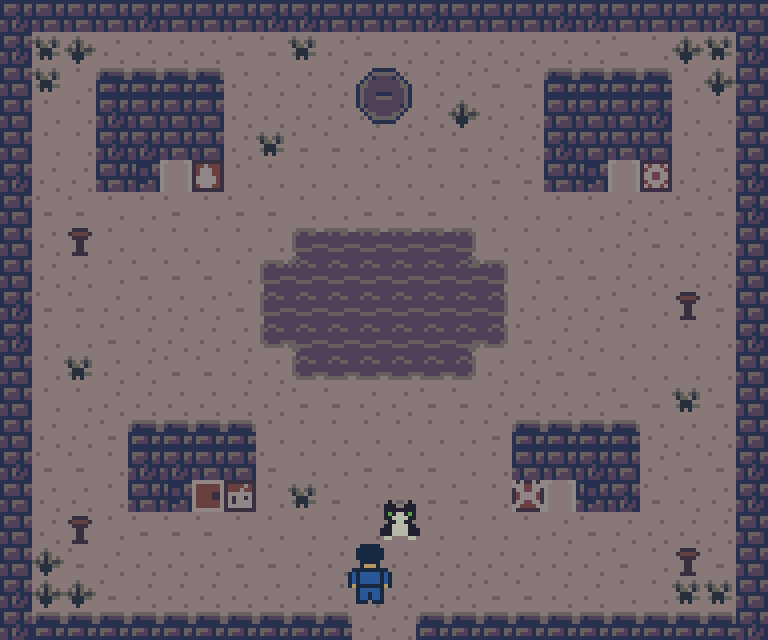
Settlement at dusk, v0.5.18. A composed full-area ROM reference with the HUD omitted. It predates the additional settlement pets and later UI changes.
The huts became places the player could enter, with different rooms for the people who lived or worked there. The opening moved to a mountain pass. A King’s Quest-style score gave the chapter another connection to its influences. These pieces helped establish what the game was becoming beyond its combat prototype.
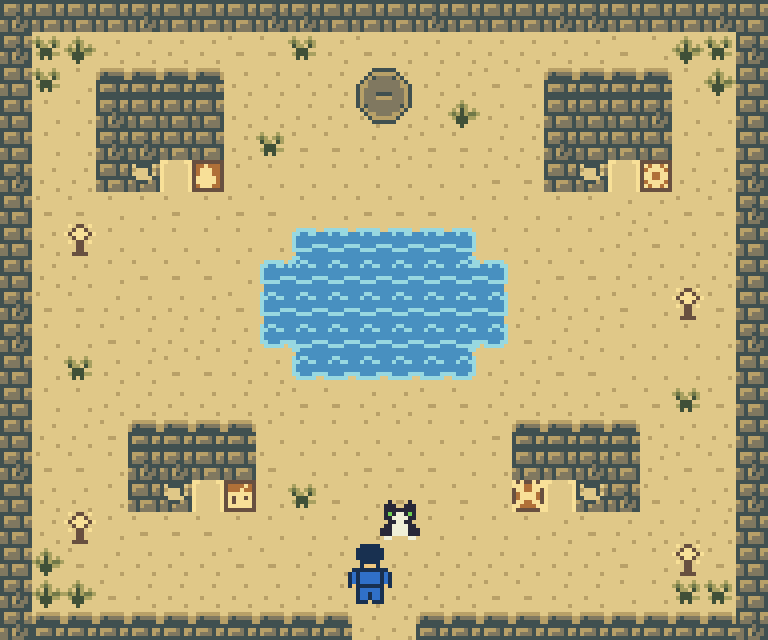
Restored settlement, v0.5.18. A composed full-area ROM reference showing the historical build.
The radio tower became the third mission, and the chapter conclusion followed on October 18. There was now a sequence someone could play through: arrive, take requests, help restore the settlement and reach an ending. It was short, but it had a shape that the first room could only suggest.
I wanted to make a love letter to the games and people who influenced me. I knew it would take care to make that authentic and heartfelt. By October 18, there was a complete chapter I could play through and review.